
SUBTITLE B: AIR POLLUTION
CHAPTER I: POLLUTION CONTROL BOARD
SUBCHAPTER c: EMISSION STANDARDS AND LIMITATIONS FOR STATIONARY SOURCES
PART 217 NITROGEN OXIDES EMISSIONS
SECTION 217.390 EMISSIONS AVERAGING PLANS
Section 217.390 Emissions Averaging Plans
a) An owner or operator of certain affected units may comply through an emissions averaging plan.
1) A unit or units that commenced operation before January 1, 2002 may be included in only one emissions averaging plan, as follows:
A) Units:
i) Located at a single source or at multiple sources in Illinois to address compliance for units identified in Section 217.386(a)(1), so long as the units are owned by the same company or parent company where the parent company has working control through stock ownership of its subsidiary corporations; or
ii) Located at a single source or at multiple sources in either the Chicago area counties or Metro-East area counties to address compliance for units identified in Section 217.386(a)(2), so long as the units are owned by the same company or parent company where the parent company has working control through stock ownership of its subsidiary corporations;
B) Units that have a compliance date later than the control period for which the averaging plan is being used for compliance;
C) Units that are not otherwise subject to this Subpart (so long as the units are owned by the same company or parent company where the parent company has working control through stock ownership of its subsidiary corporations) or that the owner or operator may claim as exempt pursuant to Section 217.386(b) but does not claim as exempt. For as long as such unit is included in an emissions averaging plan, it will be treated as an affected unit and subject to the applicable emission concentration, limits, testing, monitoring, recordkeeping and reporting requirements; and
D) Units that comply with the requirements for low usage units set forth in Section 217.388(a)(3), so long as the unit or units operate NOx emissions control technology. For as long as such unit is included in an emissions averaging plan, it will be subject to the applicable emission concentration limits in subsection (g)(7) of this Section, the applicable testing and monitoring requirements for affected units in Section 217.394(a) through (e), and the applicable recordkeeping and reporting requirements for affected and low usage units in Section 217.396(a) through (d).
2) The following types of units may not be included in an emissions averaging plan:
A) Units that commence operation after January 1, 2002, unless the unit or units replace a unit or units described in subsection (a)(1) of this Section that commenced operation on or before January 1, 2002, or the unit or units replace a unit or units described in subsection (a)(1) of this Section that replaced a unit or units described in subsection (a)(1) of this Section that commenced operation on or before January 1, 2002. The new unit must be used for the same purpose and have substantially equivalent or less process capacity or be permitted for less NOx emissions on annual basis than the actual NOx emissions of the unit or units that are replaced. The owner or operator of a unit that is shut down and replaced must comply with the provisions of Section 217.396(c)(3) before the replacement unit may be included in an emissions averaging plan.
B) Units that the owner or operator is claiming are exempt pursuant to Section 217.386(b).
b) An owner or operator must submit an emissions averaging plan to the Agency by the applicable compliance date set forth in Section 217.392, or by May 1 of the year in which the owner or operator is using a new emissions averaging plan to comply.
1) The plan must include, but is not limited to:
A) The list of affected units included in the plan by unit identification number and permit number.
B) A sample calculation demonstrating compliance using the methodology provided in subsection (f) of this Section for both the ozone season and calendar year.
2) The plan will be effective as follows:
A) An initial plan for units required to comply by January 1, 2008 is effective January 1, 2008;
B) An initial plan for units required to comply by May 1, 2010 is effective May 1, 2010 for those units;
C) A new plan submitted pursuant to subsection (b) of this Section but not submitted by January 1, 2008 or May 1, 2010 is effective retroactively to January 1 of the applicable year;
D) An amended plan submitted pursuant to subsection (c) of this Section is effective retroactively to January 1 of the applicable year; or
E) An amended plan submitted pursuant to subsection (d) of this Section is effective on the date it is received by the Agency.
c) An owner or operator may amend an emissions averaging plan only once per calendar year. An amended plan must include the information from subsection (b)(1) and may change, but is not limited to changing, the group of affected units or reflecting changes in the operation of the affected units. An amended plan must be submitted to the Agency by May 1 of the applicable calendar year and is effective as set forth in subsection (b)(2) of this Section. If an amended plan is not received by the Agency by May 1 of the applicable calendar year, the previous year's plan will be the applicable emissions averaging plan.
d) Notwithstanding subsection (c) of this Section, an owner or operator, and the buyer or seller, if applicable:
1) Must submit an updated emissions averaging plan or plans to the Agency within 60 days if a unit that is listed in an emissions averaging plan is sold or taken out of service.
2) May amend its emissions averaging plan to include another unit within 30 days after discovering that the unit no longer qualifies as an exempt unit pursuant to Section 217.386(b) or as a low usage unit pursuant to Section 217.388(a)(3).
3) May submit an updated emissions averaging plan or plans to the Agency within 60 days after purchasing a new unit to include the new unit.
e) An owner or operator must:
1) Demonstrate compliance for both the ozone season (May 1 through September 30) and the calendar year (January 1 through December 31) by using the methodology and the units listed in the most recent emissions averaging plan submitted to the Agency pursuant to subsection (b), (c), or (d) of this Section; the higher of the monitoring or test data determined pursuant to Section 217.394; and the actual hours of operation for the applicable control period;
2) Notify the Agency by October 31 following the ozone season, if compliance cannot be demonstrated for that ozone season; and
3) Submit to the Agency by January 31 following each calendar year, a compliance report containing the information required by Section 217.396(c)(4).
f) The total mass of actual NOx emissions from the units listed in the emissions averaging plan must be equal to or less than the total mass of allowable NOx emissions for those units for both the ozone season and calendar year. The following equation must be used to determine compliance:

Where:
Nact =

Nall =

|
Nact |
= |
Total sum of the actual NOx mass emissions from units included in the averaging plan for each fuel used (lbs per ozone season and calendar year). |
|
Nall |
= |
Total sum of the allowable NOx mass emissions from units included in the averaging plan for each fuel used (lbs per ozone season and calendar year). |
|
EMall(i) |
= |
Total mass of allowable NOx emissions in lbs for a unit as determined in subsection (g)(2) or (h)(2) of this Section. |
|
EMact(i) |
= |
Total mass of actual NOx emissions in lbs for a unit as determined in subsection (g)(1) or (h)(1) of this Section. |
|
i |
= |
Subscript denoting an individual unit and fuel used. |
|
n |
= |
Number of different units in the averaging plan. |
g) For each unit in the averaging plan, and each fuel used by a unit, determine actual and allowable NOx emissions using the following equations, except as provided for in subsection (h) of this Section:
1) Actual emissions must be determined as follows:

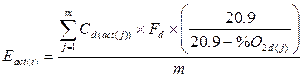
2) Allowable emissions must be determined as follows:


Where:
|
EMact(i) |
= |
Total mass of actual NOx emissions in lbs for a unit, except as provided for in subsections (g)(3) and (g)(5) of this Section. |
|
EMall(i) |
= |
Total mass of allowable NOx emissions in lbs for a unit, except as provided for in subsection (g)(3) of this Section. |
|
Eact |
= |
Actual NOx emission rate (lbs/mmBtu) calculated according to the above equation. |
|
Eall |
= |
Allowable NOx emission rate (lbs/mmBtu) calculated according to the above equation, as applicable. |
|
H |
= |
Heat input (mmBtu/ozone season or mmBtu/year) calculated from fuel flow meter and the heating value of the fuel used. |
|
Cd(act) |
= |
Actual concentration of NOx in lb/dscf (ppmv x 1.194 x10⁻⁷) on a dry basis for the fuel used. Actual concentration is determined on each of the most recent test runs or monitoring passes performed pursuant to Section 217.394, whichever is higher. |
|
Cd(all) |
= |
Allowable concentration of NOx in lb/dscf (allowable emission limit in ppmv specified in Section 217.388(a)(1), except as provided for in subsection (g)(4), (g)(5), (g)(6), or (g)(7) of this Section, if applicable, multiplied by 1.194 x 10⁻⁷) on a dry basis for the fuel used. |
|
Fd |
= |
The ratio of the gas volume of the products of combustion to the heat content of the fuel (dscf/mmBtu) as given in the table of F Factors included in 40 CFR 60, appendix A, Method 19 or as determined using 40 CFR 60, appendix A, Method 19. |
|
%O2d |
= |
Concentration of oxygen in effluent gas stream measured on a dry basis during each of the applicable tests or monitoring runs used for determining emissions, as represented by a whole number percent, e.g., for 18.7%O2d, 18.7 would be used. |
|
i |
= |
Subscript denoting an individual unit and the fuel used. |
|
j |
= |
Subscript denoting each test run or monitoring pass for an affected unit for a given fuel. |
|
m |
= |
The number of test runs or monitoring passes for an affected unit using a given fuel. |
3) For a replacement unit that is electric-powered, the allowable NOx emissions from the affected unit that was replaced should be used in the averaging calculations and the actual NOx emissions for the electric-powered replacement unit (EMact elec(i)) are zero. Allowable NOx emissions for the electric-powered replacement are calculated using the actual total bhp-hrs generated by the electric-powered replacement unit on an ozone season and on an annual basis multiplied by the allowable NOx emission rate in lb/bhp-hr of the replaced unit. The allowable mass of NOx emissions from an electric-powered replacement unit (EMall elec(i)) must be determined by multiplying the nameplate capacity of the unit by the hours operated during the ozone season or annually and the allowable NOx emission rate of the replaced unit (Eall rep) in lb/mmBtu converted to lb/bhp-hr. For this calculation the following equation should be used:

Where:
|
EMall elec(i) |
= |
Mass of allowable NOx emissions from the electric-powered replacement unit in pounds per ozone season or calendar year. |
|
bhp |
= |
Nameplate capacity of the electric-powered replacement unit in brake horsepower. |
|
OP |
= |
Operating hours during the ozone season or calendar year. |
|
F |
= |
Conversion factor of 0.0077 mmBtu/bhp-hr. |
|
Eall rep(i) |
= |
Allowable NOX emission rate (lbs/mmBtu) of the replaced unit. |
|
i |
= |
Subscript denoting an individual electric unit and the fuel used. |
4) For a replacement unit that is not electric, the allowable NOx emissions rate used in the above equations set forth in subsection (g)(2) of this Section must be the higher of the actual NOx emissions as determined by testing or monitoring data or the applicable uncontrolled NOx emissions factor from Compilation of Air Pollutant Emission Factors: AP-42, Volume I: Stationary Point and Area Sources, as incorporated by reference in Section 217.104 for the unit that was replaced.
5) For a unit that is replaced with purchased power, the allowable NOx emissions rate used in the equations set forth in subsection (g)(2) of this Section must be the emissions concentration set forth in Section 217.388(a)(1) or subsection (g)(6) of this Section, when applicable, for the type of unit that was replaced. For owners or operators replacing units with purchased power, the annual hours of operations that must be used are the calendar year hours of operation for the unit that was shut down, averaged over the three-year period prior to the shutdown. The actual NOx emissions for the units replaced by purchased power (EM(i)act) are zero. These units may be included in any emissions averaging plan for no more than five years beginning with the calendar year that the replaced unit is shut down.
6) For units that have a later compliance date, allowable emissions rate used in the equations set forth in subsection (g)(2) of this Section must be:
A) Prior to the applicable compliance date pursuant to Section 217.392, the higher of the actual NOx emissions as determined by testing or monitoring data or the applicable uncontrolled NOx emissions factor from Compilation of Air Pollutant Emission Factors: AP-42, Volume I: Stationary Point and Areas Sources, as incorporated by reference in Section 217.104; or
B) On and after the unit's applicable compliance date pursuant to Section 217.392, the applicable emissions concentration for that type of unit pursuant to Section 217.388(a)(1).
7) For a low usage unit complying with the requirements of Section 217.388(a)(3) and used in an emissions averaging plan, the allowable NOx emissions rate used in the above equations set forth in subsection (g)(2) of this Section must be the higher of the actual NOx emissions as determined by testing or monitoring data or the applicable uncontrolled NOx emissions factor from Compilation of Air Pollutant Emission Factors: AP-42, Volume I: Stationary Point and Area Sources, as incorporated by reference in Section 217.104.
h) For units that use CEMS, the data must show that the total mass of actual NOx emissions determined pursuant to subsection (h)(1) of this Section is less than or equal to the allowable NOx emissions calculated in accordance with the equations in subsections (f) and (h)(2) of this Section for both the ozone season and calendar year. The equations in subsection (g) of this Section will not apply.
1) The total mass of actual NOx emissions in lbs for a unit (EMact) must be the sum of the total mass of actual NOx emissions from each affected unit using CEMS data collected in accordance with 40 CFR 60 or 75, or alternate methodology that has been approved by the Agency or USEPA and included in a federally enforceable permit.
2) The allowable NOx emissions must be determined as follows:

Where:
|
EMall(i) |
= |
Total mass of allowable NOx emissions in lbs for a unit. |
|
flowji |
= |
Stack flow (dscf/hr) for a given stack. |
|
Cdj |
= |
Allowable concentration of NOx (ppmv) specified in Section 217.388(a)(1) for a given stack (1.194 x 10⁻⁷ converts to lb/dscf). |
|
j |
= |
subscript denoting each hour operation of a given unit. |
|
m |
= |
Total number of hours of operation of a unit. |
|
i |
= |
Subscript denoting an individual unit and the fuel used. |
(Source: Amended at 33 Ill. Reg. 11999, effective August 6, 2009)