SUBTITLE B: AIR POLLUTION
CHAPTER I: POLLUTION CONTROL BOARD
SUBCHAPTER c: EMISSION STANDARDS AND LIMITATIONS FOR STATIONARY SOURCES
PART 217 NITROGEN OXIDES EMISSIONS
SECTION 217.158 EMISSIONS AVERAGING PLANS
Section 217.158 Emissions Averaging Plans
a) Notwithstanding any other emissions averaging plan provisions under this Part, an owner or operator of a source with certain emission units subject to Subpart E, F, G, H, I, or M of this Part, or subject to Subpart Q of this Part that are located in either one of the areas set forth under Section 217.150(a)(1)(A)(i) or (ii) or Section 217.150(a)(2)(A)(i) or (ii), may demonstrate compliance with the applicable Subpart through an emissions averaging plan. An emissions averaging plan can only address emission units that are located at one source and each unit may only be covered by one emissions averaging plan. The emission units at the source are affected units and are subject to the requirements of this Section.
1) The following units may be included in an emissions averaging plan:
A) Units that commenced operation on or before January 1, 2017.
B) Before July 1, 2025, units that the owner or operator may claim as exempt under Section 217.162, 217.182, 217.202, 217.222, 217.242, or 217.342 of this Part, as applicable, but does not claim exempt. For as long as the unit is included in an emissions averaging plan, it will be treated as an affected unit and subject to the applicable emissions limitations, and testing, monitoring, recordkeeping and reporting requirements.
C) On and after July 1, 2025, units that are not otherwise subject to Subpart E, F, G, H, I, or M, as applicable, under Section 217.150(a)(2)(B), or Subpart Q, as applicable, under Section 217.386(b)(2)(A) or (B), but that the owner or operator chooses to include in an emissions averaging plan. For as long as the unit is included in an emissions averaging plan, it will be treated as an affected unit and subject to the applicable emissions limitations, testing, monitoring, recordkeeping and reporting requirements.
D) Units that commence operation after January 1, 2017, if the unit replaces a unit that commenced operation on or before January 1, 2017, or it replaces a unit that replaced a unit that commenced operation on or before January 1, 2017. The new unit must be used for the same purpose and have substantially equivalent or less process capacity or be permitted for less NOx emissions on an annual basis than the actual NOx emissions of the unit or units that are replaced. Within 90 days after permanently shutting down a unit that is replaced, the owner or operator of the unit must submit a written request to withdraw or amend the applicable permit to reflect that the unit is no longer in service before the replacement unit may be included in an emissions averaging plan.
E) On and after July 1, 2025, units that are not otherwise subject to Subpart E, F, G, H, I, or M, as applicable, under Section 217.150(a)(2)(B), but that share a common stack with a unit that is subject to Subpart E, F, G, H, I, or M, as applicable.
2) The following types of units may not be included in an emissions averaging plan:
A) Units that commence operation after January 1, 2017, except as provided by subsection (a)(1)(D) of this Section.
B) Before July 1, 2025, units that the owner or operator is claiming are exempt under Section 217.162, 217.182, 217.202, 217.222, 217.242, or 217.342 of this Part, as applicable.
C) Units that are required to meet emission limits or control requirements for NOx as provided for in an enforceable order, unless the order allows for emissions averaging. In the case of petroleum refineries, this subsection (a)(2)(C) does not prohibit including industrial boilers or process heaters, or both, in an emissions averaging plan when an enforceable order does not prohibit the reductions made under the order from also being used for compliance with any rules or regulations designed to address regional haze or the non-attainment status of any area.
b) Before July 1, 2025, an owner or operator must submit an emissions averaging plan to the Agency by January 1, 2015. The plan must include, but is not limited to, the following:
1) The list of affected units included in the plan by unit identification number; and
2) A sample calculation demonstrating compliance using the methodology provided in subsection (g) of this Section for the ozone season (May 1 through September 30) and calendar year (January 1 through December 31).
c) On and after July 1, 2025, an owner or operator must submit an emissions averaging plan to the Agency at least 30 days before beginning the use of that plan to demonstrate compliance. The plan must include, but is not limited to, the following:
1) The list of affected units included in the plan by unit identification number.
2) The allowable emissions limitation for each unit, as provided in Sections 217.164, 217.184, 217.204, 217.224, 217.244, and 217.344 of this Part, as applicable.
3) A sample calculation demonstrating compliance using the methodology provided in subsection (h) of this Section on a 30-day rolling average basis.
4) The date the owner or operator will begin using the emissions averaging plan.
d) An owner or operator may amend an emissions averaging plan only once per calendar year.
e) Notwithstanding subsection (d) of this Section:
1) If a unit that is listed in an emissions averaging plan is taken out of service, the owner or operator must submit to the Agency, within 30 days after the occurrence, an updated emissions averaging plan; or
2) Before July 1, 2025, if a unit that was exempt from the requirements of Subpart E, F, G, H, I, or M of this Part under Section 217.162, 217.182, 217.202, 217.222, 217.242, or 217.342 of this Part, as applicable, no longer qualifies for an exemption, the owner or operator may amend its existing averaging plan to include the unit within 30 days after the unit no longer qualifies for the exemption.
3) On and after July 1, 2025, if a unit that was not otherwise subject to Subpart E, F, G, H, I, or M, as applicable, under Section 217.150(a)(2)(B) becomes subject to Subpart E, F, G, H, I, or M, as applicable, the owner or operator may amend its existing averaging plan to include the unit within 30 days after the unit becomes subject to the applicable Subpart.
f) An owner or operator must:
1) Until July 1, 2025, demonstrate compliance for the ozone season (May 1 through September 30) and the calendar year (January 1 through December 31) by using the methodology and the units listed in the most recent emissions averaging plan submitted to the Agency under subsection (b) of this Section, the monitoring data or test data determined under Section 217.157, and the actual hours of operation for the applicable averaging plan period.
2) On and after July 1, 2025, demonstrate compliance on a 30-day rolling average basis by using the methodology and the units listed in the most recent emissions averaging plan submitted to the Agency under subsection (c) of this Section, the monitoring data or test data determined under Section 217.157, and the actual hours of operation for the applicable averaging plan period.
3) Until July 1, 2025, submit to the Agency, by March 1 following each calendar year, a compliance report containing the information required by Section 217.156(i). On and after July 1, 2025, submit to the Agency, by May 1 following each calendar year, a compliance report containing the information required by Section 217.156(j).
g) Until July 1, 2025, the total mass of actual NOx emissions from the units listed in the emissions averaging plan must be equal to or less than the total mass of allowable NOx emissions for those units for both the ozone season and calendar year. The following equation must be used to determine compliance:

Where:
|
|
= |
|
|
|
= |
|
|
|
= |
Total sum of the actual NOx mass emissions from units included in the averaging plan for each fuel used (tons per ozone season and year). |
|
|
= |
Total sum of the allowable NOx mass emissions from units included in the averaging plan for each fuel used (tons per ozone season and year). |
|
|
= |
Total mass of actual NOx emissions in tons for a unit as determined in subsection (f)(1) of this Section. |
|
i |
= |
Subscript denoting an individual unit. |
|
j |
= |
Subscript denoting the fuel type used. |
|
k |
= |
Number of different fuel types. |
|
n |
= |
Number of different units in the averaging plan. |
|
|
= |
Total mass of allowable NOx emissions in tons for a unit as determined in subsection (g)(2) of this Section. |






For each unit in the averaging plan, and each fuel used by the unit, determine actual and allowable NOx emissions using the following equations:
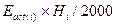
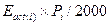
1) Actual emissions must be determined as follows:
When emission limits are prescribed in lb/mmBtu,
When emission limits are prescribed in lb/ton of processed product,
2) Allowable emissions must be determined as follows:
When emission limits are prescribed in lb/mmBtu,

When emission limits are prescribed in lb/ton of processed product,
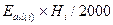
Where:
|
|
= |
Total mass of actual NOx emissions in tons for a unit. |
|
|
|
= |
Total mass of allowable NOx emissions in tons for a unit. |
|
|
|
= |
Actual NOx emission rate (lbs/mmBtu or lbs/ton of product) as determined by a performance test, a CEMS, or an alternative method approved by the Agency. |
|
|
|
= |
Allowable NOx emission rate (lbs/mmBtu or lbs/ton of product) as provided in Section 217.164, 217.184, 217.204, 217.224, 217.244, or 217.344, as applicable. For an affected industrial boiler subject to Subpart E of this Part, or process heater subject to Subpart F of this Part, with a rated heat input capacity less than or equal to 100 mmBtu/hr demonstrating compliance through an emissions averaging plan, the allowable NOx emission rate is to be determined from a performance test after the boiler or heater has undergone combustion tuning. For all other units in an emissions averaging plan, an uncontrolled NOx emission rate from USEPA's AP-42, as incorporated by reference in Section 217.104, or an uncontrolled NOx emission rate as determined by an alternative method approved by the Agency, will be used. |
|
|
H |
= |
Heat input (mmBtu/ozone season or mmBtu/year) calculated from fuel flow meter and the heating value of the fuel used. |
|
|
P |
= |
weight in tons of processed product. |
|


h) On and after July 1, 2025, the total mass of actual NOx emissions from the units listed in the emissions averaging plan must be equal to or less than the total mass of allowable NOx emissions for those units on a 30-day rolling average basis. The following equation must be used to determine compliance:

Where:
|
|
= |
|
|
|
|
Where Nact is the total sum of the actual NOx mass emissions from units included in the averaging plan for each fuel used (tons per 30-day rolling average basis). |
|
|
= |
|
|
|
|
Where Nall is the total sum of the allowable NOx mass emissions from units included in the averaging plan for each fuel used (tons per 30-day rolling average basis). |
|
|
= |
Total mass of actual NOx emissions in tons for a unit as determined in subsection (h)(1) of this Section. |
|
i |
= |
Subscript denoting an individual unit. |
|
j |
= |
Subscript denoting the fuel type used. |
|
k |
= |
Number of different fuel types. |
|
n |
= |
Number of different units in the averaging plan. |
|
|
= |
Total mass of allowable NOx emissions in tons for a unit as determined in subsection (h)(2) of this Section. |


For each unit in the averaging plan, and each fuel used by the unit, determine actual and allowable NOx emissions using the following equations:
1) Actual emissions must be determined as follows:
When emissions limitations are prescribed in lb/mmBtu,
When emissions limitations are prescribed in lb/ton of processed product,
Alternatively, for units equipped with CEMS that monitor stack flow in accordance with 40 CFR 60 or 75, or alternate methodology that has been approved by the Agency or USEPA and included in a federally enforceable permit, actual emission rate for a given unit can be determined as follows:

Where:
|
|
= |
NOx emission rate (lb/hr) as determined by a performance test, a CEMS, a PEMS, or an alternative method approved by the Agency. |
|
|
= |
1.194 x 10⁻⁷ (1.194 x 10⁻⁷ converts to (lb/dscf)/ppm) |
|
|
= |
Hourly average NOx concentration during unit operation in ppm on a dry basis for a given unit. |
|
|
= |
Hourly average volumetric flow rate during unit operation in scf/hr on a dry basis for a given unit. |


2) Allowable emissions must be determined as follows:
When emissions limitations are prescribed in lb/mmBtu,
When emissions limitations are prescribed in lb/ton of processed product,
Where:
|
|
= |
Total mass of actual NOx emissions in tons for a unit. |
|
|
= |
Total mass of allowable NOx emissions in tons for a unit. |
|
|
= |
Actual NOx emission rate (lbs/mmBtu or lbs/ton of product) as determined by a performance test, a CEMS, a PEMS, or an alternative method approved by the Agency. |
|
|
= |
Allowable NOx emission rate (lbs/mmBtu or lbs/ton of product) as provided in Section 217.164, 217.184, 217.204, 217.224, 217.244, or 217.344, as applicable. |
|
H |
= |
Heat input (mmBtu/30-day rolling average basis) calculated from fuel flow meter and the heating value of the fuel used. |
|
P |
= |
weight in tons of processed product. |
i) An owner or operator of an emission unit subject to Subpart Q of this Part that is located in either one of the areas set forth under Section 217.150(a)(1)(A)(i) or (ii) or Section 217.150(a)(2)(A)(i) or (ii) that is complying through an emissions averaging plan under this Section must comply with the applicable provisions for determining actual and allowable emissions under Section 217.390, the testing and monitoring requirements under Section 217.394, and the recordkeeping and reporting requirements under Section 217.396.
j) The owner or operator of an emission unit located at a petroleum refinery who is demonstrating compliance with an applicable Subpart through an emissions averaging plan under this Section may exclude from the calculation demonstrating compliance (i.e. 30-day rolling average under Section 217.152) those time periods when an emission unit included in the emissions averaging plan is shut down for a maintenance turnaround, provided that the requirements in subsection (j)(1) through (j)(5) are met:
1) the owner or operator notify the Agency in writing at least 30 days in advance of the shutdown of the emission unit for the maintenance turnaround;
2) the shutdown of the emission unit does not exceed 45 days per ozone season or calendar year;
3) daily emissions of the combined emission units in the emissions averaging plan during the maintenance turnaround do not exceed the turnaround daily emissions cap. The turnaround daily emissions cap is the highest average daily emissions value of the three prior calendar years, where the combined emissions of units in the emissions averaging plan are summed on a daily basis, and those values are averaged for a given calendar year. The turnaround daily emission cap is to be submitted to the Agency in the written notification described in subsection (j)(1);
4) NOx pollution control equipment, if any, continues to operate on all other emission units operating during the maintenance turnaround; and
5) the owner or operator notifies the Agency in writing within 30 days of the end of the maintenance turnaround of the actual start and end dates for the maintenance turnaround and, for each day of the maintenance turnaround, the daily emissions of the combined emission units in the emissions averaging plan.
The owner or operator must resume compliance with the 30-day rolling average on the calendar day immediately following the end of the maintenance turnaround and incorporating the operating days preceding the maintenance turnaround. For purposes of this subsection, "maintenance turnaround" means the shutdown of any emission unit or control equipment that is scheduled at least 30 days in advance of the shutdown and the purpose of such shutdown is to (1) perform general equipment cleaning and repairs due to normal equipment wear and tear; (2) perform required equipment tests and internal inspections; (3) install any unit or equipment modifications/additions, or make provisions for a future modification or addition; and/or (4) perform normal end-of-run catalyst changeouts or refurbishments.
k) Until July 1, 2025, the owner or operator of an emission unit that combusts a combination of coke oven gas and other gaseous fuels and that is located at a source that manufactures iron and steel who is demonstrating compliance with an applicable Subpart through an emissions averaging plan under this Section may exclude from the calculation demonstrating compliance those time periods when the coke oven gas desulfurization unit included in the emissions averaging plan is shut down for maintenance, provided that the owner or operator notify the Agency in writing at least 30 days in advance of the shutdown of the coke oven gas desulfurization unit for maintenance and the shutdown does not exceed 35 days per ozone season or calendar year and NOx pollution control equipment, if any, continues to operate on all other emission units operating during the maintenance period.
l) The owner or operator of an emission unit located at a petroleum refinery who is demonstrating compliance with an applicable Subpart through an emissions averaging plan under this Section may exclude from the calculation demonstrating compliance (i.e. 30-day rolling average under Section 217.152) those time periods when NOx pollution control equipment that controls one or more emission units included in the emissions averaging plan is shut down for a maintenance turnaround, provided that the requirements in subsection (l)(1) through (l)(5) are met:
1) the owner or operator notify the Agency in writing, at least 30 days in advance of the shutdown, of the NOx pollution control equipment for the maintenance turnaround;
2) the shutdown of the NOx pollution control equipment does not exceed 45 days per ozone season or calendar year;
3) daily emissions of the combined emission units in the emissions averaging plan during the maintenance turnaround do not exceed the turnaround daily emissions cap. The turnaround daily emissions cap is the highest average daily emissions value of the three prior calendar years, where the combined emissions of units in the emissions averaging plan are summed on a daily basis, and those values are averaged for a given calendar year. The turnaround daily emission cap is to be submitted to the Agency in the written notification described in subsection (l)(1);
4) except for those emission units vented to the NOx pollution control equipment undergoing the maintenance turnaround, NOx pollution control equipment, if any, continues to operate on all other emission units operating during the maintenance turnaround; and
5) the owner or operator notifies the Agency in writing within 30 days of the end of the maintenance turnaround of the actual start and end dates for the maintenance turnaround and, for each day of the maintenance turnaround, the daily emissions of the combined emission units in the emissions averaging plan.
The owner or operator must resume compliance with the 30-day rolling average on the calendar day immediately following the end of the maintenance turnaround and incorporating the operating days preceding the maintenance turnaround. For purposes of this subsection, "maintenance turnaround" means the shutdown of any emission unit or control equipment that is scheduled at least 30 days in advance of the shutdown and the purpose of such shutdown is to (1) perform general equipment cleaning and repairs due to normal equipment wear and tear; (2) perform required equipment tests and internal inspections; (3) install any unit or equipment modifications/additions, or make provisions for a future modification or addition; and/or (4) perform normal end-of-run catalyst changeouts or refurbishments.
m) Notwithstanding subsection (h), for the owner or operator of a petroleum refinery located in Channahon or Wood River, the equation used to determine compliance before January 1, 2028, is as follows:
Where Nact and Nall are defined as under subsection (h).
(Source: Amended at 49 Ill. Reg. 6355, effective April 23, 2025)